Let’s be honest: pretty much no one actually wants to use bleach.
Most of us aren’t reaching for it because we love harmful fumes, mystery splatters on our clothes, or that “did I just inhale too much of that?” feeling.
We use bleach because sometimes life gets gross.
Like diaper blowouts that somehow defy physics. Raw chicken juice on the counter right before your toddler grabs a snack. Bathroom disasters. Stomach bugs. The weird sticky mystery mess on the floor that you truly do not want to identify.
When those moments happen, you want something that actually disinfects—but a lot of families would still love to skip bleach’s harmful fumes, residues, and harsher trade-offs if there’s a better option.
That’s exactly why so many parents start looking for bleach alternatives.
In this guide, we’ll break down which bleach alternatives actually disinfect, what works, what doesn’t, and how to choose a bleach-free option that can handle real-life grossness without automatically defaulting to bleach.
Why Do So Many Families Want Bleach Alternatives?
Bleach has long been the “serious mess” default—but for many families, it can also feel like the option you use because you think you have to, not because you actually feel good about it.
For plenty of parents, bleach is less about preference and more about panic-cleaning:
- The diaper blowout
- The raw chicken contamination spiral
- The stomach bug
- The pet accident
- The “what is that and why is it wet?” moment
But many people start looking for alternatives because they want something that still handles germs effectively without the harmful fumes, residues, or irritation they may associate with bleach.
Common reasons families look for bleach alternatives include:
- Harmful fumes
- Skin or respiratory irritation
- Residues on high-touch surfaces
- Concerns around frequent use
- Kids, pets, asthma, allergies, or sensitive skin
If you’ve ever wondered whether bleach is truly your best or only option, Bleach in Cleaning Products: What It Is, How It Works & What to Know breaks down why so many families start reconsidering it in the first place.
What Makes a Good Bleach Alternative?
A good bleach alternative isn’t just something that sounds gentler—it still has to work when life gets legitimately gross.
Because when you’re disinfecting after raw meat, a stomach bug, or a bathroom situation, “clean enough” and “actually disinfected” are not always the same thing.
The best bleach alternative should:
- Actually disinfect when disinfecting is needed
- Have clear EPA-registered disinfecting claims if germ-kill is your goal
- Minimize harmful fumes or residues when possible
- Be practical for the surfaces you use most
- Feel safe enough for regular real-life use
In other words: the goal isn’t to downgrade from bleach—it’s to find something that can still do the gross-job moments, but in a way that may better fit your family.
Best Bleach Alternatives for Disinfecting
Hypochlorous Acid
Hypochlorous acid is one of the most compelling bleach alternatives because it can disinfect effectively while offering a different safety profile than traditional bleach.
For families, this can be especially appealing because it’s not just about replacing bleach in theory—it’s about having something that can tackle diaper stations, high chairs, raw chicken counters, bathroom messes, and everyday germy chaos without feeling like you’re trading one problem for another.
If your biggest question is simply what to use instead of bleach, What Is a Safer Alternative to Bleach? Hypochlorous Acid Explained dives deeper into why hypochlorous acid is increasingly becoming that answer for many families.
And if you’re wondering whether hypochlorous acid truly holds up when things get gross, Is Hypochlorous Acid as Effective as Bleach? explores how it compares from a germ-kill perspective, while Is Hypochlorous Acid Safer Than Bleach? focuses more on safety trade-offs.
For the full science breakdown, Bleach vs Hypochlorous Acid: What’s the Difference? explains how these ingredients differ chemically and practically.
Hydrogen Peroxide
Hydrogen peroxide can disinfect certain surfaces and may be a fit for some households, but formulation, concentration, and pathogen-specific effectiveness vary. For example, it doesn’t kill some pathogens like Pseudomonas aeruginosa.
Alcohol-Based Disinfectants
Alcohol can work well for certain disinfecting needs, but it may not always be the most practical option for families with children and pets given its safety profile. Not all alcohol-based products are equally effective against every pathogen, so organism-specific claims matter. For example non-enveloped viruses like Norovirus are resistant to alcohol.
Thymol or Botanical Disinfectants
Some botanical disinfectants use ingredients like thymol, but “plant-based” doesn’t automatically mean best for every family. If you’ve got sensitive skin, asthma, allergies, or strong scent sensitivities, botanical disinfectants may not be right for your family.
What Doesn’t Always Replace Bleach?
This is where a lot of people get misled.
Some products may sound like bleach alternatives online—but that doesn’t always mean they disinfect the way you need them to when things get truly gross.
Soap and Water
Soap and water can absolutely be great for cleaning dirt, grime, and plenty of everyday messes—but cleaning and killing germs to meet EPA-required levels are not the same thing.
Vinegar
Vinegar gets talked about a lot online, but for many of the germ-kill situations families actually worry about, it’s not the bleach replacement people often hope it is. It’s not an EPA-registered disinfectant or sanitizer.
“Natural” Cleaners
Natural doesn’t automatically mean disinfecting. If your child just had a stomach bug or raw chicken leaked all over your kitchen counter, this distinction matters.
Which Bleach Alternative Is Best for Families, Babies & Sensitive Homes?
For many moms, this really comes down to one question:
“Can this handle the gross stuff without making me feel like I’m coating my home in something I hate using?”
The best bleach alternative for families is one that:
- Actually disinfects
- Minimizes residues or extra rinse steps
- Does not require rinsing
- Avoids fragrance and dyes
- Feels practical enough for regular life
Because with kids, babies, pets, and everyday chaos, you usually don’t need something that sounds good in theory—you need something you can have at the ready when things get gross.
If your priorities also include broader family-safe cleaning beyond bleach alternatives alone, it can help to understand how to choose safer cleaning products for kids, babies, and sensitive families, how cleaning chemicals may affect babies and how to reduce exposure, and what to look for in asthma- and allergy-conscious cleaning products.
When Bleach Still Gets Used
For some families, bleach may still absolutely have specific uses.
But for a lot of parents, the real question isn’t “Is bleach bad?”
It’s:
“Do I really need bleach for this…or is there something else that can do the job without everything I dislike about it?”
That’s where understanding your options matters.
The Bottom Line
The best bleach alternative is the one that can handle real-life messes, actually disinfect when needed, and align with your family’s safety priorities.
Because parenthood is already full of enough gross surprises—you deserve disinfecting options that work without automatically assuming bleach is your only serious choice.
For many families, bleach alternatives like hypochlorous acid may offer one of the strongest combinations of disinfecting power and safer regular use—but the right fit depends on your home, your messes, and what helps you feel confident cleaning them up.
Is Force of Nature a Good Bleach Alternative?
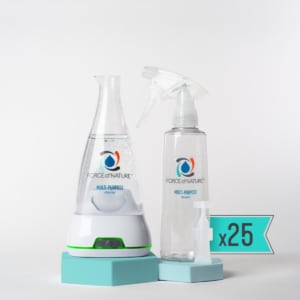
If you’re looking for a bleach alternative that balances disinfecting power with family-conscious safety, Force of Nature is one option built specifically for that goal.
Force of Nature’s active disinfecting ingredient is hypochlorous acid—a disinfecting compound powerful enough to kill 99.9% of germs when used as directed, but made without many of the harmful fumes or residues families are often trying to avoid.
As an EPA-registered disinfectant, Force of Nature is designed to tackle real-life grossness—from diaper blowouts to raw chicken counters to bathroom messes—while offering a non-toxic approach to disinfecting that can fit more safely into regular family life.
Learn more about how hypochlorous acid works, how Force of Nature works, and how its disinfecting performance compares.