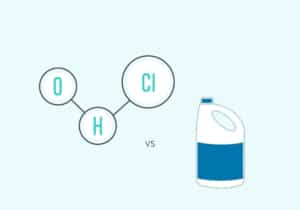
If you’re wondering whether hypochlorous acid (HOCl) works as well as bleach, you’re probably asking:
“Okay… but does it actually work? To really kill germs?”
Because let’s be honest – bleach has been the gold standard for disinfecting forever. It’s what we reach for when we want something really clean.
Does Hypochlorous Acid Really Work as Well as Bleach?
If hypochlorous acid (HOCl) is supposed to replace bleach, it has to do more than sound safer. It has to prove it can actually kill germs. We all know what happens when someone comes home from daycare with a tummy ache or the sniffles…
If you’re still getting familiar with how bleach and hypochlorous acid compare, here’s a quick breakdown of the difference between bleach and hypochlorous acid. If you’re comparing disinfectants beyond bleach and hypochlorous acid, see Best Bleach Alternatives for Disinfecting: What Actually Works?
Short Answer: Yes – Hypochlorous Acid Can Be Just as Effective as Bleach
When made at the right concentration and used as directed, hypochlorous acid can:
- Kill 99.9% of viruses and bacteria
- Work as a hospital-grade disinfectant
- Be EPA-registered for disinfecting
That concentration piece really matters.
Not all hypochlorous acid products are created equal – many bottled versions on the market are formulated at levels too low to meet EPA standards for disinfecting surfaces. And, hypochlorous acid (HOCl) has a shelf life, so after about 2 weeks, it dips below EPA germ-killing requirements for surface disinfecting.
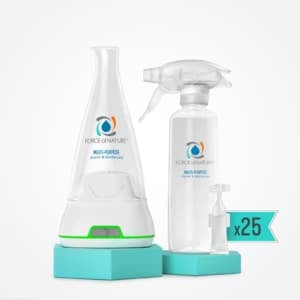
That’s why Force of Nature’s system is different. Force of Nature generates hypochlorous acid at the specific concentration required to disinfect, so you’re getting proven germ-killing power, not just a surface cleaner.
👉 It’s not just what the ingredient is – it’s how it’s made and used.
Why Hypochlorous Acid Works So Well
Hypochlorous acid (HOCl) isn’t new – it’s actually been used for years in wound care, eye care, and hospitals.
Your immune system even produces it to kill bacteria and viruses.
So instead of relying on harsh chemicals like traditional bleach (sodium hypochlorite), hypochlorous acid works in a way that’s:
- Highly effective at breaking down pathogens
- Fast-acting on surfaces
- Much gentler on skin and surfaces
If you’re curious how it’s made, here’s a deeper look at how hypochlorous acid is created through electrolyzed water.
Hypochlorous Acid vs Bleach: Effectiveness Compared
Here’s how they stack up when it comes to performance:
Bleach (Sodium Hypochlorite):
- Strong disinfectant
- Kills a broad range of germs
- Requires careful handling and ventilation
Hypochlorous Acid:
- Also kills 99.9% of germs when used as directed on hard, non-porous surfaces
- Can be an EPA-registered disinfectant if at the right concentration like Force of Nature
- Effective against common bacteria and viruses
- No harsh fumes or toxic residues to rinse
👉 In real-world use, both can disinfect effectively – it’s not about whether it works, it’s about how it works.
To understand this comparison, it helps to know how bleach works as a disinfectant.
For help choosing a disinfectant that balances effectiveness with safety, see What Is the Safest Disinfectant? (And What Actually Kills Germs).
Does Hypochlorous Acid Kill the Same Germs as Bleach?
Yes – when properly formulated and used as directed, hypochlorous acid can kill many of the same types of germs, including:
- Influenza A (flu virus)
- Norovirus
- Salmonella
- E. coli
- Staph (including MRSA)
- Listeria
- Pseudomonas
Force of Nature is EPA-registered and appears on multiple EPA disinfectant lists like List N for SARS-CoV-2 and:
👉 In other words: this isn’t a “gentle alternative” that sacrifices effectiveness – Force of Nature’s formula is a medical-grade disinfectant and sanitizer.
What About Cleaning Power?
Disinfecting is one thing, but what about messes?
Independent lab testing of Force of Nature has shown it performs as well as leading household cleaners when it comes to:
- Cutting grease
- Cleaning glass
- Removing soap scum
- Eliminating odors
What makes it especially effective as a deodorizer is how it works.
Instead of masking smells, hypochlorous acid actually kills the bacteria, mold, and mildew that cause odors in the first place – which is why it works so well on things like kitty litter, sports gear, trash cans, pet areas, and musty surfaces.
So you’re not trading cleaning performance for effectiveness, you’re getting both.
So Why Do People Still Use Bleach?
Mostly because it’s familiar.
Bleach has been around forever, so we’ve been taught: “If you want something truly disinfected, use bleach.”
But now we know there are other options that meet the same disinfecting standards without the same drawbacks.
If you’re exploring what to use instead, here’s a guide to what to use instead of bleach.
The Bottom Line
If your biggest concern is whether hypochlorous acid actually works, here’s the takeaway:
Yes – hypochlorous acid can be just as effective as bleach at killing germs when at the right concentration and used as directed.
The real difference isn’t effectiveness, it’s what comes along with it.
Curious About Safety?
If you’re wondering whether hypochlorous acid is safer for your home, kids, or pets, that’s a whole different (and important) question.
👉 Is Hypochlorous Acid Safer Than Bleach?