If you’ve ever turned over a bottle of laundry detergent, squinted at the ingredient list and thought, Am I seriously supposed to know what all of this means?, you’re in very good company.
Most of us are asking for something pretty simple: a laundry detergent that gets clothes really clean without a bunch of ingredients we don’t want. Maybe you’re trying to avoid fragrance. Maybe someone in your house has sensitive skin. Maybe you want less plastic. Or maybe you’ve just reached the point where you just want to understand what’s washing your family’s pajamas, towels and sheets every week.
The good news is that choosing a non-toxic laundry detergent doesn’t require becoming an amateur chemist. It helps to know what claims like “non-toxic,” “fragrance-free,” “Free & Clear” and “natural” actually tell you—and, just as importantly, what they don’t.
What Does “Non-Toxic Laundry Detergent” Actually Mean?
First, a little housekeeping: “non-toxic” does not mean “chemical-free.” Water is a chemical. So are the ingredients that actually do the work of lifting dirt and stains from your clothes. A detergent made with literally no chemicals would be…an empty box, which admittedly would be very gentle but not especially helpful on spaghetti sauce.
“Non-toxic” is a product safety claim. The Federal Trade Commission says companies making a non-toxic claim should have evidence to support that the product is safe for both people and the environment.
So instead of treating “non-toxic” as a magic word on the front of a package, look at the evidence behind the product:
- What ingredients are in it?
- What ingredients are intentionally left out?
- Does it have independent safety or sensitive-skin credentials?
- Has its cleaning performance actually been tested?
- Are its environmental claims specific and substantiated?
That tells you a lot more than a leafy package and the word “natural” ever will.
What Should You Look for in a Non-Toxic Laundry Detergent?
We’d start with five things: cleaning performance, ingredients, fragrance, independent credentials and environmental impact.
Because here’s the thing: a detergent can have a beautifully simple ingredient story, but if it can’t get ketchup out of a white T-shirt, you’re probably not going to keep buying it. We are still doing laundry here.
1. Start With Cleaning Performance
We put this first on purpose.
You shouldn’t have to choose between a detergent that works and one whose ingredients you feel good about using around your family. Look for actual performance evidence rather than assuming that “natural,” “eco-friendly” or “non-toxic” automatically means effective—or ineffective.
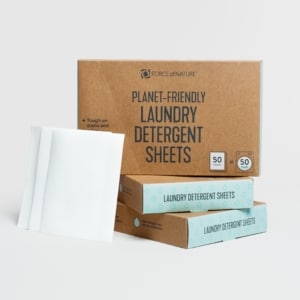
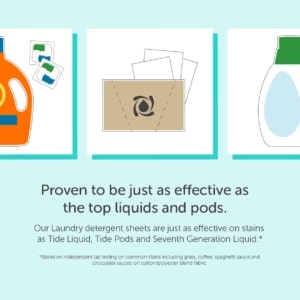
Force of Nature Laundry Detergent Sheets were independently tested in a 3rd-party lab and proven to be just as effective on common stains as Tide Liquid, Tide Pods and Seventh Generation Liquid.
If you’re wondering whether that tiny sheet can really hold its own against a traditional detergent, our guide to whether laundry detergent sheets really work digs much deeper into cleaning performance, stain removal, cold-water use and HE washers.
2. If You Want to Avoid Fragrance, Look for Truly Fragrance-Free
Fragrance is one of the first things we’d look at, especially for families with sensitive skin or fragrance sensitivities.
A study published in the journal Dermatitis looked at common allergens listed in 65 popular textile-care products and found fragrance and essential oils were the most commonly identified allergens in laundry detergents.
If avoiding fragrance matters to you, look for a product that clearly says fragrance-free and check the ingredients and any independent certifications behind that claim. For example, the EPA’s Safer Choice program has specific criteria for products that qualify for its Fragrance-Free designation, including a review to confirm that fragrance materials aren’t present.
And remember that fragrance isn’t what makes laundry clean. Your kids may strongly disagree because apparently “Mountain Spring Explosion” smells like cleanliness to a 12-year-old, but cleaning and scent are two different jobs.
3. Look Beyond “Free & Clear”
“Free & Clear” can be a useful clue, but it shouldn’t be the end of your investigation.
Different brands can mean different things by front-of-package terms, so look at what the product specifically says it is free of and check the actual ingredient information when it’s available.
That same study of popular textile-care products found common allergens in some detergents marketed as “baby safe” and “free and gentle.” That doesn’t mean every Free & Clear detergent is problematic. It means the marketing phrase alone doesn’t tell you everything about the formula.
In other words: flip the package over. We know, thrilling stuff. But it’s worth the 20 seconds.
4. Know the Preservatives You May Want to Check For
If you or someone in your family has known skin sensitivities or allergies, you may also want to look for certain preservatives used in some laundry products.
Three names worth recognizing are:
- Methylisothiazolinone, also called MIT
- Methylchloroisothiazolinone, also called CMIT
- Benzisothiazolinone, also called BIT
These preservatives help protect products from microbial growth, but isothiazolinones are also recognized contact allergens. The textile-care product study mentioned above identified MIT, CMIT and BIT among common allergens found in laundering products.
This doesn’t mean everyone needs to fear every preservative. It does mean that if your family is specifically trying to avoid isothiazolinones—or someone has already been diagnosed with a sensitivity—the ingredient list matters.
If skin reactions are part of the reason you’re changing detergents, our guide to laundry detergent allergies, sensitive skin and ingredients to watch for goes deeper into that topic.
5. Decide Which Other Ingredients Matter to You
Families make different choices here, and we don’t think you need a 47-item “NEVER LET THIS CHEMICAL INTO YOUR HOUSE” list taped to the laundry-room wall.
You may prefer a detergent made without things like:
- Added fragrance
- Dyes
- Optical brighteners
- Bleach
- Phthalates (often used in fragranced products to make scents last)
- Parabens
- Phosphates
- Isothiazolinone preservatives such as MIT, CMIT or BIT
The important part is understanding why you’re avoiding something instead of assuming that a long chemical-looking word is automatically bad and a plant-looking word is automatically good.
Is Fragrance-Free Laundry Detergent the Same as Non-Toxic Laundry Detergent?
No. Fragrance-free tells you something important about fragrance; it does not tell you everything about the rest of the formula.
A fragrance-free detergent may still contain dyes, preservatives, optical brighteners or other ingredients you’re trying to avoid. And conversely, a fragranced detergent isn’t automatically identical to every other fragranced detergent.
Think of “fragrance-free” as one decision criterion rather than a complete safety rating.
If avoiding fragrance is your top priority, choose a genuinely fragrance-free product. If your goal is broader—such as finding a non-toxic detergent for your family—keep reading the rest of the ingredient and product information too.
Does “Natural Laundry Detergent” Mean Non-Toxic?
Not necessarily.
“Natural” tells you very little by itself about how well a detergent cleans, whether it contains ingredients that may bother sensitive skin, or whether its environmental claims have been independently evaluated.
We’d rather see specifics:
- Fragrance-free
- Dye-free
- Clear ingredient information
- Independent skin-safety certifications
- Actual cleaning-performance testing
- Specific environmental claims instead of vague “green” language
Basically, evidence beats adjectives.
What About “Chemical-Free Laundry Detergent”?
This is one of those phrases that sounds wonderful until chemistry crashes the party.
There really isn’t such a thing as chemical-free laundry detergent because every ingredient—including water—is made of chemicals.
Usually when someone searches for “chemical-free laundry detergent,” what they actually mean is:
“I want an effective detergent without ingredients I’m trying to avoid.”
That’s a much more useful standard. Instead of looking for a product with “no chemicals,” look for a formula that clearly tells you what it contains, what it leaves out and what evidence supports its safety and performance claims.
Is a Non-Toxic Laundry Detergent Better for Sensitive Skin?
It can be a good place to start, but sensitive skin deserves its own checklist.
If eczema, allergies or irritation are concerns in your family, look closely at fragrance, dyes and known allergens in the formula like MIT, CMIT and BIT, and pay attention to independent sensitive-skin certifications.
Force of Nature Laundry Detergent Sheets are free from fragrances, dyes, allergens and irritants for people with sensitive skin and eczema. They have earned the National Eczema Association Seal of Acceptance.
And one important bit of perspective: not every rash that appears after laundry day is automatically an allergy to detergent. Dermatology research suggests true allergic contact dermatitis caused by laundry detergent itself may be relatively uncommon, which is another reason we prefer thoughtful ingredient evaluation over blanket fear of “chemicals.”
Does the Detergent Format Matter?
Sheets, liquid detergent and pods can all be made with very different formulas. The format itself does not make a detergent non-toxic.
What the format does change is things like dosing, packaging, storage, mess and how much water you’re shipping around.
If you’re deciding between formats, our comparison of laundry detergent sheets vs pods vs liquid detergent walks through cleaning performance, dosing flexibility, convenience, plastic packaging, storage and cost side by side.
What About the Environmental Side of Your Laundry Detergent?
If “non-toxic” to you includes wanting a product that makes sense environmentally too, look beyond ingredients.
Packaging and product concentration matter. A large jug of liquid detergent requires packaging and transporting a lot more weight and volume than a concentrated sheet. And specific claims are more useful than a vague “eco-friendly” badge.
Force of Nature Laundry Detergent Sheets come in recyclable paper packaging instead of a single-use plastic detergent jug. They’re also biodegradable in accordance with OECD 310D. They are also certified carbon neutral by Climate Partner.
If reducing plastic is one of your biggest priorities, our guide to eco-friendly and plastic-free laundry detergent takes a deeper look at packaging, shipping weight, biodegradability and other sustainability considerations.
Do Non-Toxic Laundry Detergents Really Work?
Yes—if the formula is good enough. Non-toxic doesn’t have to mean less effective. The important thing is to look for actual cleaning-performance evidence rather than assuming a detergent is either better or worse because of how it’s marketed.
This was one of the biggest things we wanted to prove when we developed Force of Nature Laundry Detergent Sheets. Because “better ingredients” isn’t much consolation when your child comes home wearing half the soccer field.
So we had the sheets independently tested in a 3rd-party lab.
The result: Force of Nature Laundry Detergent Sheets were proven to be just as effective on common stains as Tide Liquid, Tide Pods and Seventh Generation Liquid.
That’s the sweet spot we think families are actually looking for: the cleaning performance of a leading detergent without having to accept every ingredient or plastic jug that traditionally came with it.
Why Force of Nature Laundry Detergent Sheets?
We made Force of Nature Laundry Detergent Sheets for families who don’t want to choose between powerful cleaning and a formula they feel good about using.
They’re:
- Independently tested in a 3rd-party lab and proven just as effective on common stains as Tide Liquid, Tide Pods and Seventh Generation Liquid
- Fragrance-free
- Dye-free
- Made without phosphates, optical brighteners, bleach, phthalates or parabens
- Made without MIT, CMIT or BIT preservatives
- Awarded the National Eczema Association Seal of Acceptance and free from allergens and irritants for people with sensitive skin
- Carbon neutral certified by Climate Partner
- Packaged in recyclable paper instead of a single-use plastic detergent jug
- Biodegradable in accordance with OECD 310D
- Certified cruelty-free by Leaping Bunny
And because they’re concentrated into a tiny sheet, there’s no giant jug, no measuring and—one small victory we will never stop appreciating—no sticky detergent cap.
If you want a detergent that can handle the actual mess of family life without a bunch of extras you’d rather skip, that’s exactly what we made them for.
Shop Force of Nature Laundry Detergent Sheets
Your Questions About Non-Toxic Laundry Detergent, Answered
What does non-toxic laundry detergent mean?
“Non-toxic” is not a claim with a standardized definition from a regulatory standpoint. Rather than relying on the words on the front of the package, look at the actual formula, which ingredients are intentionally left out, independent safety or sensitive-skin certifications, and whether the product’s performance and environmental claims are backed by evidence.
What is the safest laundry detergent?
There isn’t one laundry detergent that’s automatically safest for everyone. Look at the full formula, ingredients you specifically want to avoid, whether it’s fragrance-free and dye-free, independent sensitive-skin certifications, and whether its safety and performance claims are backed by evidence. For families with sensitive skin or eczema, credentials like the National Eczema Association Seal of Acceptance can be especially helpful.
Is Free & Clear laundry detergent non-toxic?
Not necessarily. “Free & Clear” can be a useful clue, but different brands can mean different things by the term. Check what the product specifically says it is free of and review the ingredient information rather than relying on the front-of-package claim alone.
What ingredients should you avoid in laundry detergent?
That depends on your priorities and sensitivities, but some families look for detergents without added fragrance, dyes, optical brighteners, bleach, phthalates, phosphates or isothiazolinone preservatives such as methylisothiazolinone (MIT), methylchloroisothiazolinone (CMIT) and benzisothiazolinone (BIT).
Is there such a thing as chemical-free laundry detergent?
Not literally. Everything is made of chemicals, including water and the ingredients that actually clean your clothes. When people search for “chemical-free laundry detergent,” they usually mean they want an effective detergent without certain ingredients they’re trying to avoid, such as added fragrance, dyes or specific preservatives.
What laundry detergent is best for sensitive skin?
If sensitive skin, eczema or allergies are a concern, look closely at fragrance, dyes and known allergens in the formula, as well as independent sensitive-skin credentials. Force of Nature Laundry Detergent Sheets are fragrance-free, dye-free and free from allergens and irritants to people with sensitive skin. They have earned the National Eczema Association Seal of Acceptance.
Do non-toxic laundry detergents clean as effectively as conventional detergents?
They can. Cleaning performance depends on the formula, not whether a detergent is marketed as non-toxic or conventional. Force of Nature Laundry Detergent Sheets were independently tested in a 3rd-party lab and proven to be just as effective on common stains as Tide Liquid, Tide Pods and Seventh Generation Liquid.
Can a non-toxic laundry detergent also be eco-friendly?
Yes, but look for specific evidence rather than vague “green” claims. Force of Nature Laundry Detergent Sheets come in recyclable paper packaging, are biodegradable in accordance with OECD 310D, and are Certified Carbon Neutral by ClimatePartner. Their concentrated sheet format also eliminates the need for a single-use plastic detergent jug.