If you’re trying to make your laundry routine a little more eco-friendly, the good news is that you don’t have to start washing everything by hand in a rain barrel.
A few surprisingly simple choices can make a meaningful difference: using less single-use plastic, avoiding products that ship a lot of unnecessary water, choosing formulas that have actually been tested for biodegradability, using the right amount of detergent and looking for environmental claims that have real evidence behind them.
And because laundry is one of those chores that just keeps regenerating—especially if there are children anywhere in the vicinity—we’re big believers in changes that are sustainable for the planet and sustainable for your sanity.
What Makes a Laundry Detergent Eco-Friendly?
There isn’t one single feature that automatically makes a laundry detergent “eco-friendly.” A green-looking package or a leaf on the label certainly doesn’t tell the whole story.
We’d look at the full picture:
- Packaging: How much single-use plastic does it use?
- Concentration: Are you shipping a heavy bottle of liquid, or a compact concentrated product?
- Ingredients: What happens to the detergent after it goes down the drain?
- Biodegradability: Has the finished product actually been evaluated using a recognized test method?
- Sourcing: If the package is paper, is there evidence behind where that material came from?
- Usage: Does the format make it easy to use only as much detergent as you need?
- Climate impact: Are emissions claims specific and backed by evidence?
Basically, “eco-friendly” should be more than a vibe.
1. Start by Reducing Plastic Laundry Detergent Packaging
For most of us, traditional laundry detergent means one of two things: a big plastic jug of liquid or a plastic container filled with pods.
And once the detergent is gone, that container has to go somewhere.
Plastic bottles are often estimated to take around 450 years to break down. That number is an estimate rather than an expiration date stamped on every detergent jug, but the larger point is hard to miss: plastic can persist in the environment for a very long time.
So if reducing household plastic is one of your goals, laundry detergent is a pretty painless place to look. You’re already buying it over and over again. Changing the packaging means you can reduce recurring plastic waste without adding another job to your life—which, frankly, is our favorite category of sustainability.
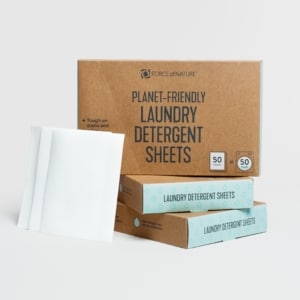
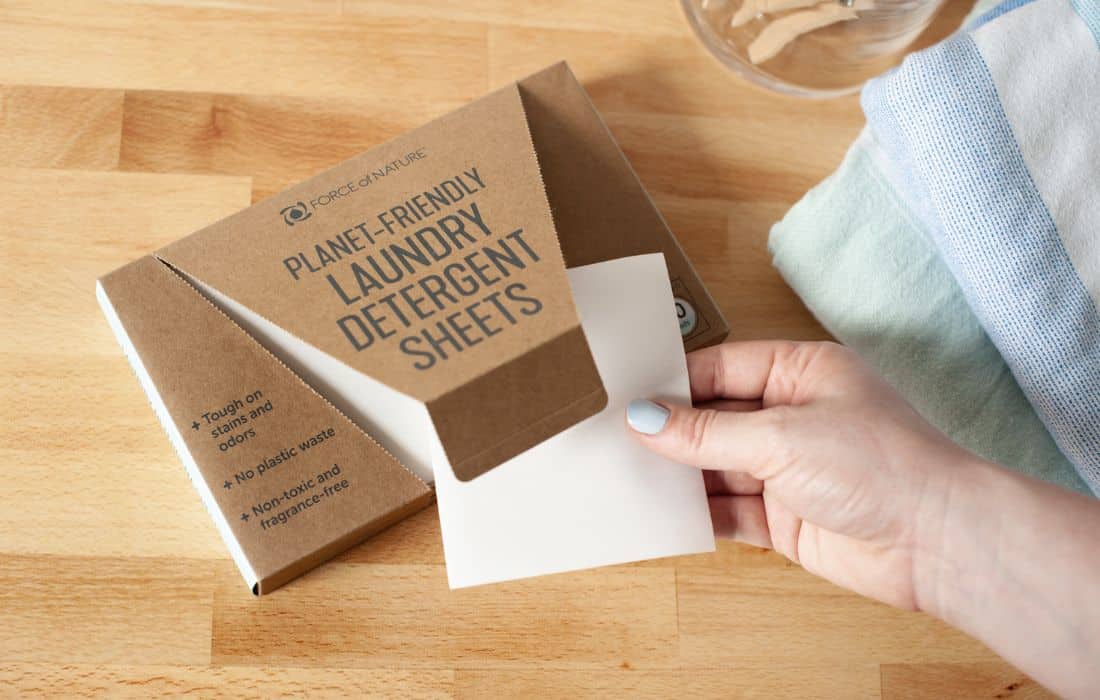
Force of Nature Laundry Detergent Sheets eliminate the need for a single-use plastic detergent jug and come in recyclable paper packaging.
2. Stop Shipping So Much Water Around
This is the part of liquid laundry detergent that’s easy to overlook.
Liquid detergent is…well, liquid. That means every bottle has to be manufactured, packed, shipped to a warehouse, shipped to a retailer or your house, and hauled into the laundry room with all that weight inside it.
Concentrated formats like laundry detergent sheets dramatically reduce the weight and volume that need to move through the supply chain.
Force of Nature Laundry Detergent Sheets have 94% lower emissions than liquid detergents and are Certified Carbon Neutral by ClimatePartner. They also take up 95% less space than a typical liquid laundry detergent jug for the same number of loads.
Which means no shipping a giant bottle of liquid around just to get detergent into your washing machine—and no performing the oddly specific upper-body workout known as “lifting the 100-load jug over a pile of laundry.”
3. Look at What Happens After Detergent Goes Down the Drain
Packaging gets most of the attention when we talk about eco-friendly laundry, but what happens after you use the detergent matters too.
Once the washing machine drains, that water enters the wastewater system. Detergent ingredients can ultimately interact with wastewater treatment processes and the broader environment.
A scientific review of detergents, natural ecosystems and wastewater treatment found that detergent components can affect aquatic and terrestrial ecosystems and can also affect wastewater treatment processes.
That doesn’t mean “all detergent is bad for the environment.” It means the environmental profile of the formula—and whether it can biodegrade—are legitimate things to consider, not just what the package looks like.
If ingredients are also part of what you’re trying to rethink, our guide to choosing a non-toxic laundry detergent breaks down fragrance, dyes, preservatives and other ingredients you may want to evaluate.
4. Do Laundry Detergent Sheets Biodegrade?
This is an important question because many laundry detergent sheets use polyvinyl alcohol—often called PVA or PVOH—as part of the material that holds the concentrated detergent.
PVA is a water-soluble synthetic polymer, which means it dissolves in the wash. But here’s the important distinction: dissolving and biodegrading aren’t the same thing.
Something can dissolve in water without necessarily breaking down biologically afterward. So the question is: has the finished product actually been tested for biodegradability?
OECD Test No. 301B evaluates the biodegradability of a substance aqueous aerobic environment. Force of Nature Laundry Detergent Sheets are biodegradable in accordance with OECD Test No. 301B.
5. Use the Right Amount of Laundry Detergent
One of the easiest ways to make laundry less wasteful costs exactly zero dollars: stop using more detergent than you need.
More detergent does not automatically mean cleaner clothes.
In fact, Consumer Reports’ laundry expert recommends against using too much detergent because excess concentrated detergent can leave residue behind, waste product and contribute to buildup in the washing machine.
If you’ve ever looked at a detergent cap and thought, Is that line one? Line three? Am I supposed to be wearing my reading glasses for laundry now?, this is one advantage of pre-measured formats.
Force of Nature Laundry Detergent Sheets make dosing pretty simple: use half a sheet for a small load or handwashing, one sheet for a regular-to-large load and two sheets for an extra-large load.
No pouring an optimistic glug into the cap because the soccer uniforms look particularly tragic that day.
6. Look for Evidence Behind Environmental Claims
Words like “green,” “sustainable,” “eco-friendly” and “planet-friendly” sound lovely. But they’re a lot more useful when you can figure out what the company actually means by them.
We’d look for specific claims and independent standards where possible.
For Force of Nature Laundry Detergent Sheets, that includes:
- Biodegradable in accordance with OECD Test No. 301B
- Certified Carbon Neutral by ClimatePartner
- 94% lower emissions than liquid detergents
Specific evidence beats vague green language every time.
7. Consider the Carbon Impact, Not Just the Trash Can
Plastic waste is easy to see. Emissions are less obvious because they don’t accumulate next to the recycling bin.
But manufacturing, packaging and moving products around all contribute to emissions—which is why concentration and shipping weight matter.
Force of Nature Laundry Detergent Sheets have 94% lower emissions than liquid detergents and are Certified Carbon Neutral by ClimatePartner.
For us, those are useful environmental proof points because they go beyond simply saying “our box is smaller.”
Are Laundry Detergent Sheets More Eco-Friendly Than Liquid Detergent?
They can have some pretty meaningful environmental advantages.
Compared with traditional liquid detergent, laundry sheets can:
- Eliminate the need for a large single-use plastic detergent jug
- Use compact paper packaging
- Reduce shipping weight and volume
- Take up dramatically less storage space
- Make it easier to control how much detergent you use
But—and this is important—not every laundry detergent sheet is automatically eco-friendly.
You still want to look at the specific formula, whether it has been tested for biodegradability using a recognized test method, the packaging, sourcing and the evidence behind any environmental claims the brand makes.
If you’re deciding whether sheets, pods or liquid detergent fit your family best overall, our laundry detergent sheets vs pods vs liquid detergent comparison looks at cleaning performance, dosing, packaging, storage and convenience side by side.
But Do Eco-Friendly Laundry Detergents Actually Work?
This is the part we would never bury under a mountain of sustainability claims.
You still need clean clothes.
An environmentally thoughtful detergent that leaves peanut butter, grass stains and whatever-that-is on the kids’ clothes isn’t exactly solving the problem.
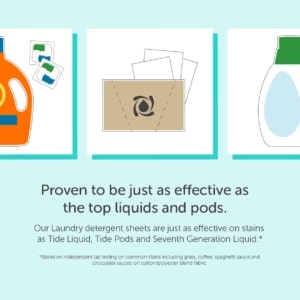
Force of Nature Laundry Detergent Sheets were independently tested in a 3rd-party lab and proven to be just as effective on common stains as Tide Liquid, Tide Pods and Seventh Generation Liquid.
So reducing plastic and shipping weight doesn’t have to mean lowering your standards for cleaning.
If you’re wondering whether detergent sheets really can keep up with traditional formats, our guide to whether laundry detergent sheets really work digs into performance, stains, cold-water washing and HE machines.
Why We Chose Laundry Detergent Sheets
When we developed Force of Nature Laundry Detergent Sheets, we wanted to tackle several kinds of waste at once—not just replace a plastic jug with a different package.
They’re:
- Packaged in recycled material
- Biodegradable in accordance with OECD Test No. 301B
- 94% lower in emissions than liquid detergents
- Certified Carbon Neutral by ClimatePartner
- 95% more space-efficient than a typical liquid detergent jug for the same number of loads
- Pre-measured to make it easy to use the right amount
- Independently tested in a 3rd-party lab and proven just as effective on common stains as Tide Liquid, Tide Pods and Seventh Generation Liquid
In other words, the goal wasn’t to make laundry feel like an environmental virtue project. It was to make one thing your family already does all the time create less plastic packaging, less shipping weight and less waste—without making the actual laundry part harder.
Shop Force of Nature Laundry Detergent Sheets
A Few More Easy Ways to Make Laundry More Eco-Friendly
Your detergent matters, but you don’t have to stop there.
- Use the recommended detergent dose. More isn’t better, and excess detergent is simply more product going into the wash.
- Wash full—but not overstuffed—loads. You want to use washer capacity efficiently while still leaving enough room for clothes and detergent solution to circulate.
- Use cold water when it works for your laundry. Force of Nature Laundry Detergent Sheets dissolve and clean in cold, warm or hot water.
- Skip laundry extras you don’t need. Fabric softener, scent boosters and extra detergent can sometimes contribute to buildup that traps odors instead of solving them. If stubborn smells are part of your laundry routine, our guide to how to deodorize laundry naturally and stop stubborn odors explains which laundry habits may actually be making the problem worse.
- Take care of your clothes. Keeping clothes usable longer means fewer things need to be replaced prematurely.
No composting your socks required.
Your Questions About Eco-Friendly Laundry Detergent, Answered
Are laundry detergent sheets eco-friendly?
They can be, but not every laundry detergent sheet is automatically eco-friendly. Look at the packaging, shipping weight, ingredients, biodegradability testing and evidence behind the brand’s environmental claims. Many detergent sheets use polyvinyl alcohol (PVA or PVOH) as part of the sheet, so it’s also important to distinguish between simply dissolving in water and actually biodegrading. Force of Nature Laundry Detergent Sheets ingredients are biodegradable in accordance with OECD 301B, eliminate the single-use plastic detergent jug, and come in recyclable paper packaging.
Do laundry detergent sheets biodegrade?
It depends on the product. Many laundry detergent sheets contain PVA, a water-soluble synthetic polymer, but dissolving and biodegrading are not the same thing. If environmental persistence is your concern, look for biodegradability based on testing rather than assuming all sheets behave the same way. Force of Nature Laundry Detergent Sheets ingredients are biodegradable in accordance with OECD 301B, a standardized test method used to evaluate biodegradability.
How can you reduce plastic waste when doing laundry?
Start with recurring packaging. Choosing detergent that doesn’t require a large single-use plastic jug can reduce one source of household plastic waste. You can also skip unnecessary laundry extras, avoid using more detergent than you need, and choose concentrated products that use less packaging and shipping space.
Are eco-friendly laundry detergents as effective as regular detergent?
They can be. Cleaning performance depends on the formula, not whether the product is a sheet, liquid or pod. Force of Nature Laundry Detergent Sheets were independently tested in a 3rd-party lab and proven to be just as effective on common stains as Tide Liquid, Tide Pods and Seventh Generation Liquid.
What should you look for in an eco-friendly laundry detergent?
Look beyond vague “green” claims and check for specific evidence around packaging, biodegradability, recycled or responsibly sourced materials, product concentration, emissions and cleaning performance. Independent standards and certifications can make those claims much easier to evaluate.