This guide is a little different. Instead of just explaining what to look for or why certain products can trigger symptoms, we’re going to get to the question you probably actually came here with: What should I use?
We’ll walk through which types of cleaning products and formulas work best—and why they may be better choices for asthma- and allergy-sensitive homes. Because nobody has time to stand in the cleaning aisle Googling six ingredients while the tiny passenger in your cart is asking for—and reaching for—every neon-colored snack you’re trying to speed past.
If you want a deeper explanation of how cleaning products can trigger symptoms in the first place, you can read more about how cleaning products affect asthma and how to reduce triggers at home.
What “Best” Cleaning Products for Asthma and Allergies Really Means
When it comes to asthma and allergies, the “best” cleaning product isn’t just about how well it cleans. It’s also about the ingredients you’re exposed to and how the product is used in your home.
In other words, a cleaner doesn’t get bonus points for cutting through grease if you have to open three windows every time you use it.
The goal is to choose products that:
- Don’t contain fragrance
- Avoid common concerns like bleach, quats, thymol, dyes and certain preservatives
- Use formulas that are appropriate for the sensitivities in your household
- Still clean and disinfect effectively
If you’re still evaluating ingredients, you can explore a full breakdown in our Cleaning Product Ingredient Glossary.
What to Avoid in Cleaning Products for Asthma and Allergies
Before comparing cleaning products, it helps to screen out formulas with ingredients that may be concerns for asthma- or allergy-sensitive households. These can include fragrance, bleach, quaternary ammonium compounds (quats), thymol, dyes and preservatives such as MIT and CMIT.
Spray delivery can also increase airborne exposure, so people who are sensitive to aerosols or fumes may want to pay attention not just to what’s in the bottle, but also to how the product is applied.
You don’t need to memorize an encyclopedia of cleaning chemicals. A few filters can make the process much easier.
For a deeper explanation of these ingredients and what to look for instead, see our guide to allergy- and asthma-safe cleaning products.
Best Types of Cleaning Products for Asthma and Allergies
Once you know what to avoid, the next question is: what should you actually choose?
Instead of getting lost in dozens of individual brands, it can be more useful to compare the types of formulas available and how well they fit the needs of an asthma- or allergy-sensitive household.
1. Fragrance-Free Cleaning Products
Fragrance can be a trigger for people with asthma, allergies or sensitivities. Choosing products labeled “fragrance-free” helps reduce exposure to added fragrance ingredients.
And yes, the wording on the bottle matters here: “unscented” isn’t necessarily the same thing as fragrance-free, since some unscented products may contain ingredients used to mask odors from the other ingredients in the formula.
If you want to understand why fragrance can be problematic, here’s a deeper look at fragrance in cleaning products and how it can affect sensitive households.
2. Dye- and Preservative-Free Formulas
Dyes don’t improve cleaning performance, and they can be concerns for people with allergies or sensitive skin. That bright blue color may look reassuringly “clean,” but it isn’t what’s getting the counter clean.
Preservatives are important for extending the shelf life of liquid products, but some can be problematic for people with sensitivities. MIT and CMIT, for example, are preservatives used in some household products that are known contact allergens.
If these ingredients are a concern for your household, check ingredient labels rather than relying only on claims like “natural” or “green.” Those words can be helpful clues, but they don’t tell you exactly what’s in the formula.
3. Hypochlorous Acid–Based Cleaners
Hypochlorous acid is a disinfecting ingredient used in skincare and wound-healing products, as well as medical-grade disinfectants. It can provide effective disinfecting without relying on bleach, quaternary ammonium compounds, or thymol.
For households that need to disinfect but want to avoid those traditional disinfecting ingredients, hypochlorous acid can be an option worth considering.
And if “hypochlorous acid” sounds like something you should have learned in chemistry class and absolutely do not remember, you’re in good company. Here’s a simple explanation of what hypochlorous acid is and why it’s used for cleaning and disinfection.
4. Multi-Purpose Cleaning Products
This one is easy to underestimate.
Using one product for multiple jobs can simplify your routine and reduce the number of different formulas used throughout your home. It also means fewer bottles under the sink, fewer products to remember, and fewer moments of wondering whether the bathroom spray can also go on the kitchen counter.
Instead of separate kitchen, bathroom, glass, deodorizing and disinfecting products, a multi-purpose option that handles several of those jobs can be especially useful in households trying to reduce exposure to unnecessary ingredients.
If skin irritation is also a concern in your home, here’s how to choose cleaning products for eczema-prone and sensitive skin.
For help choosing disinfectants that better balance safety with germ-kill, see What Is the Safest Disinfectant? (And What Actually Kills Germs).
How to Choose the Best Cleaning Products for Your Home
There isn’t one formula that works for every household. The best choice depends on the sensitivities you’re trying to manage, what you need the product to do and how you use it.
The good news: you don’t need to make this complicated. Start with the issue that matters most in your home.
- If fragrance is a trigger: Choose products labeled fragrance-free rather than relying on terms like “natural” or “unscented.”
- If allergies or sensitive skin are a concern: Check the ingredient list for known contact allergens such as MIT and CMIT, as well as other ingredients that may be triggers for your household, including thymol or dyes.
- If asthma or respiratory irritation is the main concern: Look for fragrance-free products and consider how the product is applied, since aerosols and airborne sprays can increase exposure.
- If you need to disinfect: Look for an EPA-registered disinfectant that is effective against the germs you need to kill and consider avoiding ingredients like bleach, quats, and thymol.
- If you’re trying to simplify your routine: Consider a multi-purpose product that can replace several separate cleaning products. One bottle that can handle most of the house is a beautiful thing.
- If you clean surfaces used for food or by young children: Check whether the product requires rinsing after use and follow the label directions carefully.
For a step-by-step guide to evaluating ingredients and formulas, see what to look for in allergy- and asthma-safe cleaning products.
A Simpler Approach to Cleaning for Asthma- and Allergy-Sensitive Homes
For many families, the goal isn’t just to avoid individual ingredients. It’s to simplify the entire cleaning routine while still getting the cleaning and disinfecting performance you need.
Because the answer to “How can I make my home healthier?” probably shouldn’t be “Buy seven more cleaning products.”
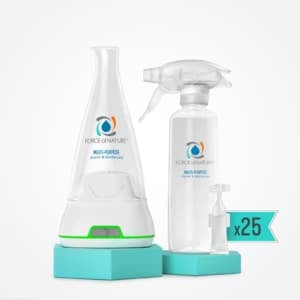
Force of Nature is one example of a system designed with this in mind. It uses electricity to convert salt, water and vinegar into a multi-purpose cleaner, deodorizer and EPA-registered disinfectant powered by hypochlorous acid.
Force of Nature has no added fragrance, dyes or preservatives and contains no bleach, quats or ammonia. One formula can be used in place of separate kitchen, bathroom and glass cleaners, deodorizers, sanitizers and disinfectants.
It also kills 99.9% of germs when used as directed, so households that need to disinfect don’t have to choose between effective germ-kill and tricky ingredients.
You can also see how Force of Nature is designed for homes with asthma, allergies, kids and pets.