If you’re worried about Salmonella in your kitchen or home, the good news is that you can kill it with the right disinfectant. The key is to use an EPA-registered disinfectant that has been tested against Salmonella and to follow the product’s directions, including the full contact time.
Force of Nature is one example: it’s an EPA-registered disinfectant that kills 99.9% of germs, including Salmonella, in 2 minutes when used as directed. More on that below — but first, here’s what actually matters when you’re trying to get Salmonella off household surfaces.
What Kills Salmonella on Surfaces?
To kill Salmonella, use an EPA-registered disinfectant that has been tested to prove efficacy against Salmonella. The EPA-registered part matters, because not all cleaning products are disinfectants. A product may be great at cleaning up crumbs, grease, or sticky fingerprints without necessarily being proven to disinfect against a specific pathogen.
Look for an EPA-registered disinfectant tested against Salmonella
EPA-registered disinfectants have to meet specific efficacy requirements for the germs listed on their labels. So if Salmonella is the germ you’re concerned about, look for a disinfectant that specifically lists Salmonella among the organisms it has been tested to kill.
Force of Nature is an EPA-registered hospital disinfectant that has been tested against Salmonella enterica. You can see the full list of organisms it has been tested against on the Force of Nature cleaning and disinfecting test results page.
Why contact time matters
This is the part that’s easy to miss when you’re trying to clean a kitchen at approximately the speed of light: disinfectants need time to work.
The contact time, sometimes called dwell time, is the amount of time a surface needs to remain wet with the disinfectant in order to kill the germs listed on the label. Spraying and immediately wiping may clean a surface, but it may not disinfect it.
Force of Nature kills 99.9% of germs including Salmonella on hard, non-porous surfaces in 2 minutes when used as directed, which means the surface should remain wet for the full 2-minute contact time.
Cleaning vs. Sanitizing vs. Disinfecting: What’s the Difference?
Cleaning, sanitizing, and disinfecting are often used like they mean the same thing, but they do different jobs.
Cleaning removes dirt, grease, food residue, and other messes from a surface. Products labeled as “cleaning” products aren’t required to kill germs.
Sanitizing reduces the number of germs on a surface to levels established by local public health standards. The required reduction depends on the type of sanitizer and its intended use.
Disinfecting kills 99.9% of a specific set of pathogens listed on a disinfectant’s label when the product is used according to directions.
If you want a deeper explanation of how the three differ, our guide to cleaning vs. sanitizing vs. disinfecting breaks it all down.
Cleaning and disinfecting do different jobs
Think of cleaning as handling the mess and disinfecting as handling the germs. If there’s grease, food residue, or visible grime on a surface, remove that first so the disinfectant can come into contact with the whole surface.
And if germs are what you’re concerned about — Salmonella after handling raw food, a stomach bug moving through the house, flu season, or just that mysterious kid-related grossness no one wants to investigate too closely — that’s when disinfecting comes into play.
Safely disinfecting your home
It’s ingrained in most of us to reach for the bleach when you have a serious germ event in your home (looking at you, Salmonella!). Understandably, a lot of families are looking for alternatives to traditional disinfectants that rely on ingredients like bleach or quaternary ammonium compounds (quats).
When you choose a disinfectant made with ingredients you feel comfortable using around your home, you don’t have to worry about reaching for it when germs are on your mind. An example of a disinfectant that’s safe to use around families, even on food prep surfaces, is Force of Nature.
Force of Nature uses hypochlorous acid as its disinfecting ingredient and contains no bleach, quats, ammonia, or fragrances. So whether you’re specifically concerned about Salmonella, want to disinfect a high-touch surface, or just want to deodorize the kitchen after dinner, you can use the same formula without turning every disinfecting job into a hazmat situation.
Where Can Salmonella Spread in the Home?
Salmonella concerns often start in the kitchen because the bacteria can be transferred from contaminated food, hands, utensils, or packaging to other surfaces.
That means it’s worth paying particular attention to surfaces that get touched during food prep, including countertops, cutting boards, sink and faucet handles, refrigerator handles, appliance handles, and other nearby high-touch areas.
Kitchen surfaces deserve extra attention
Cross-contamination can happen surprisingly easily. You handle raw food, touch the faucet, open the refrigerator, grab a cabinet handle — and suddenly the places that never touched the food directly are part of the picture.
That’s why good food safety involves both safe food-handling habits and cleaning and disinfecting the surfaces around you. For households that need to be especially cautious about foodborne illness, our guide to food safety and kitchen cleaning for immunocompromised households goes into those precautions in more detail.
How to Clean and Disinfect After Possible Salmonella Contamination
If you think a surface may have been exposed to Salmonella, the process is pretty straightforward: remove the mess, apply a disinfectant proven to kill Salmonella, and give it the full contact time listed on the label.
1. Clean away food and visible mess first
Remove food residue, grease, crumbs, or other visible soil so the disinfectant can come into contact with the entire surface. If a surface is visibly dirty, disinfectant can’t do its job as effectively if it’s trying to work through a layer of yesterday’s dinner.
2. Apply a disinfectant that kills Salmonella
Use an EPA-registered disinfectant that has been tested against Salmonella, and apply enough product to thoroughly wet the surface.
Force of Nature can both clean and disinfect, so you can use the same formula for both steps. It’s tested against Salmonella enterica and kills 99.9% of germs in 2 minutes when used as directed.
3. Keep the surface wet for the full contact time
This is the moment to resist the urge to spray-and-swipe. Let the disinfectant sit for the full amount of time required on its label.
For Force of Nature, that means spraying the surface thoroughly and letting it sit for 2 minutes. Consider it two glorious minutes when the cleaner is doing the work and you are officially allowed to do something else.
4. Follow directions for food-contact surfaces
Always follow the disinfectant label for surfaces that come into contact with food. Some disinfectants require a potable-water rinse after use on food-contact surfaces.
Force of Nature does not require rinsing on food-contact surfaces when used according to label directions, which makes it especially handy in the kitchen when you’re bouncing between countertops, cutting boards, high chairs, and everything else that somehow needs attention at the same time.
Does Hypochlorous Acid Kill Salmonella?
Hypochlorous acid, often shortened to HOCl, can be an effective antimicrobial ingredient, but it’s important not to assume that every product containing hypochlorous acid has the same germ-killing claims.
A disinfectant’s effectiveness depends on the complete formulation, including factors such as concentration and pH, as well as how the finished product has been tested and registered.
Why the specific product matters
Seeing “hypochlorous acid” on a label does not automatically mean a product is an EPA-registered disinfectant or that it has been tested against Salmonella.
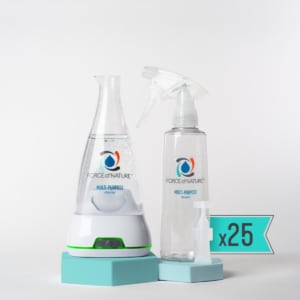
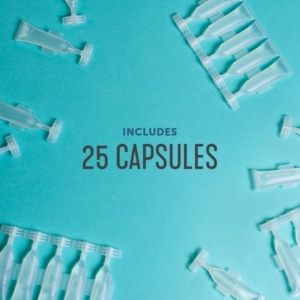
Force of Nature is different because it is EPA-registered and has been tested against Salmonella. The Force of Nature appliance uses electricity to convert tap water plus an Activator Capsule containing salt, water, and vinegar into a multi-purpose cleaner, deodorizer, sanitizer, and EPA-registered disinfectant containing hypochlorous acid.
If you’d like to understand more about the ingredient itself, our guide to what hypochlorous acid is and how it works explains the science in plain English.
Does Force of Nature Kill Salmonella?
Yes. Force of Nature is an EPA-registered hospital disinfectant tested against Salmonella enterica. It kills 99.9% of germs including Salmonella on hard, non-porous surfaces in 2 minutes when used as directed.
And unlike a typical disinfectant that only does one job, Force of Nature is also a multi-purpose cleaner and deodorizer. It can handle everyday grease, grime, spills, sticky messes, and odors, and disinfect germy surfaces.
It contains no bleach, quats, ammonia, or fragrance, so you don’t have to choose between something that kills Salmonella and something you feel good about using throughout your home.
You can see the independent cleaning performance testing and EPA-registered pathogen claims on the Force of Nature test results page.
Do Vinegar or DIY Cleaners Kill Salmonella?
Vinegar is handy for some cleaning jobs, but it is not an EPA-registered disinfectant, so it should not be relied on when your goal is to kill Salmonella.
That distinction can get confusing because Force of Nature uses vinegar as one of the ingredients in its Activator Capsule. But Force of Nature is not simply vinegar and water. The appliance uses electricity to convert water, salt, and vinegar into a new solution containing hypochlorous acid, and the finished formula is EPA-registered as a disinfectant.
If vinegar is one of your go-to DIY cleaners, our guide to whether vinegar disinfects and what it can and can’t kill explains where it works well and where it falls short.
The Bottom Line: If You’re Worried About Salmonella, Use a Disinfectant Proven to Kill It
If Salmonella is the germ you’re concerned about, choose an EPA-registered disinfectant that has actually been tested against Salmonella, and give it the full contact time required on the label.
Force of Nature is tested against Salmonella and kills 99.9% of germs on hard, non-porous surfaces in 2 minutes when used as directed. And because its hypochlorous-acid formula contains no bleach, quats, ammonia, or fragrances, you can feel comfortable using it around your family. You can also feel comfortable using it on your food prep surfaces without rinsing.