If you’ve ever sprayed a cleaner and thought, “Ahh, that smells clean,” you’re definitely not alone.
We’ve all been taught that fresh scents = a clean home. Think: laundry straight from the dryer, a lemony kitchen spray, or that “just cleaned” smell after wiping down counters.
But here’s the part most of us don’t realize:
That scent usually isn’t cleaning anything—it’s just covering things up.
And in many cases, it can introduce ingredients you’d probably never choose for your home if they were clearly listed.
This guide is part of our Cleaning Product Ingredient Glossary, where we break down what’s really in everyday products and what to watch for.
What Does “Fragrance” Actually Mean?
When you see “fragrance” or “parfum” on a label, it’s not just one ingredient.
It can represent a mixture of dozens—or even hundreds—of chemicals bundled under a single word.
Because fragrance formulas are considered trade secrets, companies aren’t required to disclose what’s inside. That means:
- You can’t see what you’re actually being exposed to
- Even brands that look “clean” can still contain hidden ingredients
Research has found that fragrance chemicals can be linked to cancer, reproductive toxicity, allergies, and sensitivities—which is a big deal when you’re using these products around your home every day.
Why Fragrance Can Be a Problem
1. Fragrance is linked to multiple health concerns
Studies have found that chemicals used in fragrance can be associated with:
- Allergies and skin irritation
- Asthma triggers
- Hormone disruption
- Even certain carcinogenic compounds
Some of these risks are highlighted in research referenced by organizations like EWG, which has found that fragrance chemicals can be associated with allergies, dermatitis, respiratory distress, and potential effects on the reproductive system.
2. Fragrance often contains phthalates
Phthalates are commonly used to help scents last longer.
Studies have shown that more than 75% of fragranced products may contain phthalates, even when they’re not listed on the label.
These are known as endocrine disruptors, meaning they can interfere with the body’s hormone systems.
If you want to go deeper, check out our guide to phthalates.
3. You won’t see the full ingredient list
Manufacturers can legally list everything simply as “fragrance,” even if it contains dozens of individual chemicals.
That lack of transparency makes it hard to:
- Avoid specific ingredients
- Compare products
- Know what you’re actually bringing into your home
4. Fragrance is a common trigger for asthma and sensitivities
If you’ve ever gotten a headache walking down the cleaning aisle or felt irritated after using a scented spray, you’re not imagining it.
Fragrance is one of the most common triggers for:
- Asthma symptoms
- Respiratory irritation
- Skin reactions
If this is something you’re navigating at home, this guide on best cleaning products for asthma and allergies is a helpful place to start.
5. “Natural fragrance” doesn’t mean safer
There’s no strict regulation around the term “natural fragrance,” and some plant-based ingredients can still trigger allergies or irritation.
So unfortunately, “natural” doesn’t automatically mean “gentle.”
6. Fragrance can impact your indoor air quality
Fragrance chemicals often release volatile organic compounds (VOCs) into the air.
Research has found that fragrance emissions can contribute to indoor air pollution, ozone formation, and fine particulate matter—which isn’t exactly what you want in your home air.
7. Smell ≠ clean
A product can smell amazing and still:
- Leave germs behind
- Contain harsh chemicals
- Add unnecessary exposure
And a product can have no scent at all and still clean and disinfect effectively.
How to Avoid Fragrance in Cleaning Products
If you’re trying to reduce exposure, a few simple shifts can go a long way:
- Look for “fragrance-free” (and still check labels carefully)
- Be cautious with “unscented” (it can still include masking fragrance)
- Skip “natural fragrance” unless ingredients are fully disclosed
- Choose products that are transparent about what’s inside
A Simpler Way to Clean—Without Fragrance
If you’re tired of trying to decode labels, there are options that skip fragrance altogether.
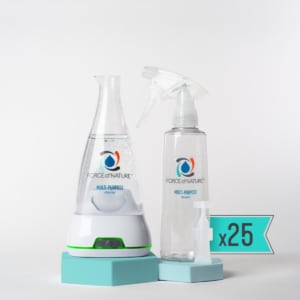
Force of Nature is a small appliance that uses tap water plus a capsule of salt, water, and vinegar to create a multi-purpose cleaner, deodorizer, and EPA-registered disinfectant.
It has no added fragrance, dyes, preservatives, or irritants.
And it kills 99.9% of germs on hard, non-porous surfaces.
So instead of relying on scent to feel like something is clean, you actually know it is.
Learn More About Ingredients to Avoid
FAQs About Fragrance in Cleaning Products
What does “fragrance” mean in cleaning products?
Are fragrances in cleaning products harmful?
Do fragrances contain phthalates?
What’s the difference between fragrance-free and unscented?
Can fragrance trigger asthma or allergies?
Do you need fragrance for something to be clean?
No. Fragrance does not contribute to cleaning or disinfecting performance—it only adds scent. What actually matters is whether a product can remove dirt and kill germs. Fragrance-free products can absolutely do both. For example, Force of Nature is an EPA-registered disinfectant, multi-purpose cleaner, and deodorizer—with no added fragrances. It kills 99.9% of germs when used as directed.