If you’ve been wondering whether electrolyzed water is really different from bleach, you’re not alone.
At first glance, they can sound surprisingly similar. Both are used for disinfecting, both are tied to chlorine chemistry, and both are talked about as alternatives to traditional cleaners.
But once you look a little closer, electrolyzed water and bleach are actually very different—in how they’re made, how they work, and how they’re used around your home.
What Is Electrolyzed Water – and How Is It Different From Bleach?
Bleach and hypochlorous acid are both used to disinfect, but they’re not the same. If you’ve ever wondered whether electrolyzed water is just another form of bleach—or how it actually compares—this guide breaks down the key differences, how each works, and when each is typically used in your home.
What Is Electrolyzed Water (Hypochlorous Acid)?
If you’ve ever stood in the cleaning aisle wondering if there’s a way to disinfect your home without relying on harsh chemicals like bleach, you’re not alone.
Electrolyzed water is a technology that’s been used for years in industrial and medical settings to create a cleaner and disinfectant that’s both effective and gentle. Hospitals use it for its balance of effectiveness and gentleness, and it’s commonly used in wound care because it can clean without being harsh on skin. It’s also used in commercial settings for cleaning and disinfecting.
The process uses electricity to transform salt, water, and vinegar into two key components:
- Sodium hydroxide – a common detergent used at different concentrations in everyday products like skincare and toothpaste.
- Hypochlorous acid (HOCl) – an antimicrobial that’s actually the same substance your white blood cells produce to fight infection.
Because of this, hypochlorous acid has been widely studied for its ability to kill bacteria and microbes while still being gentle enough for everyday use on surfaces around your home. It’s also used in food safety applications like preserving fresh produce and is even approved for use in organic crop production.
Now that you know what electrolyzed water is, let’s look at how it compares to bleach so you can clearly understand the difference.
How Is Electrolyzed Water Different Than Bleach?
Bleach and hypochlorous acid are both used to disinfect, but they’re not the same—and understanding the difference starts with how they’re made and how they behave.
For starters, they have different chemical structures. The formula for sodium hypochlorite is NaOCl, while the formula for hypochlorous acid is HOCl.
Bleach is defined as:
- Having a pH of 11+
- Being at a concentration high enough to remove the color from fabric
- Being composed of 99%+ sodium hypochlorite
None of these apply to hypochlorous acid.
Hypochlorous acid exists at a much lower concentration and a very different pH—and it’s the same substance your body naturally produces to fight infection. It’s also gentle enough to be used in applications like wound care.
There’s also an interesting connection between the two: when bleach is acidified, hypochlorite can convert into hypochlorous acid. But in household cleaning products, they are formulated, stored, and used very differently.
Both bleach and hypochlorous acid can disinfect when used as directed on hard, non-porous surfaces, but they differ in how they’re produced, how they’re handled, and where they’re typically used in everyday cleaning. CDC guidance on cleaning and disinfecting surfaces explains when cleaning is enough and when disinfecting is needed.
HOCl vs Bleach: Comparing Typical Uses
Because of these differences, bleach and hypochlorous acid tend to show up in different parts of everyday life.
Hypochlorous acid is used across a surprisingly wide range of applications—from everyday household cleaning to wound care, eye care, veterinary products, and food safety—because it can disinfect while still being gentle on skin and surfaces.
Bleach is more commonly used for disinfecting hard, non-porous surfaces and for whitening and stain removal in laundry, where its strength is useful. Surface disinfectants are regulated by the EPA, including products that appear on EPA’s list of disinfectants approved for use against viruses like SARS-CoV-2.
Why Is Bleach Still So Common?
If electrolyzed water has been around for so long, it’s a fair question—why is bleach still everywhere?
One big reason is accessibility. Traditionally, electrolyzed water required large, expensive equipment to produce, so it wasn’t something most households could easily use.
Another key difference is stability. Bleach is shelf-stable and can sit in a bottle for long periods of time. Hypochlorous acid, on the other hand, gradually loses strength over time—similar to how carbonation fades in a soda.
That difference in shelf life plays a big role in how each product is packaged, sold, and used in everyday cleaning routines.
How Electrolyzed Water Is Made
At its core, the process is simple: electricity is used to transform salt, water, and vinegar into hypochlorous acid and a small amount of sodium hydroxide (at a very low, non-toxic concentration).
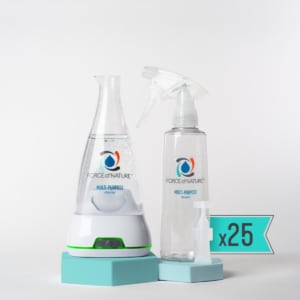
Force of Nature uses this same technology to make hypochlorous acid on demand, right on your countertop—so it’s always fresh when you use it.
If you want to understand how that translates to real-world cleaning and disinfecting performance, you can explore more here:
- Does Force of Nature actually work?
- Does Force of Nature kill norovirus?
- Independent cleaning and disinfecting test results
- What is hypochlorous acid?
Can Hypochlorous Acid Replace Bleach?
That’s usually the next question—can hypochlorous acid actually replace bleach in your home?
The answer depends on what you’re cleaning and how you’re using it.
If you’re trying to decide whether to make the switch, you can learn more about using hypochlorous acid as a safer alternative to bleach here: What is a safer alternative to bleach?