If you’ve ever stood in the cleaning aisle squinting at labels and wondering whether “natural,” “green,” “plant-based,” and “non-toxic” actually mean anything different… welcome. You are among friends.
The good news? You don’t need a chemistry degree—or 47 tabs open on your phone—to choose cleaning products you feel good about using around your family.
The trick is knowing what matters, what’s mostly marketing, and whether the product actually does the job you need it to do. Because a cleaner can have a lovely ingredient list and still be lousy at cleaning. And a product can call itself “natural” without necessarily being the safer choice. That’s because there are no regulations around the use of the term “natural” when it comes to cleaning products.
Here’s what to look for when you’re trying to find the best non-toxic cleaning products for your home.
First: What Does “Non-Toxic” Actually Mean?
Here’s the slightly annoying part: “non-toxic” isn’t a magic stamp that tells you everything you need to know about a cleaning product.
That means it’s worth looking beyond the front of the bottle and asking a few more questions:
- What ingredients does it contain?
- Which ingredients does it leave out?
- Is it fragranced?
- Has it been independently tested?
- Does it actually clean well?
- If you need it to kill germs, is it proven to do that?
- Does it deodorize—or simply cover odors with fragrance?
- If it claims to sanitize or disinfect, is it EPA registered to do that?
- Are there credible third-party certifications behind its safety or environmental claims?
That gives you a much better picture than a leaf on the label and the word “natural” in a pretty font.
And if you’ve wondered whether “natural,” “non-toxic,” and “chemical-free” are all basically the same thing, they’re not. Our guide to natural vs. non-toxic cleaning products explains why those terms can get confusing fast.
What Should You Look for in a Non-Toxic Cleaner?
There isn’t one single formula that makes a cleaning product “non-toxic”. But there are a few things we think are worth paying close attention to.
1. A short list of ingredients you can actually evaluate
You don’t necessarily need to recognize every ingredient by name. Plenty of perfectly useful ingredients have names that sound like they belong in AP Chemistry.
What matters more is transparency.
Can you find the full ingredient list? Does the company explain what those ingredients actually do? Are there ingredients you specifically want to avoid? Cleaning product manufacturers are not required to disclose their full ingredient list on product labels, so even some quick research can be worth it.
If you’d like to go deeper, our cleaning product ingredient glossary explains common cleaning ingredients and what they’re doing in your spray bottle.
2. No fragrances or dyes
Ah, “Mountain Meadow Morning Breeze.” What mountain? Which meadow? Nobody knows.
Fragrance is one of those things that can make a house smell clean without actually making it any cleaner. And if your family is dealing with asthma, allergies, eczema, migraines, babies, or sensitive skin, fragrance may be something you’d rather skip altogether.
Dyes are another example of an ingredient type that doesn’t add to a product’s performance. They might make the formula a pretty blue or lavender color, but they can also introduce challenges for families concerned about skin or respiratory sensitivities.
If sensitivities are part of the equation in your house, our guide to asthma- and allergy-safe cleaning products goes into what to look for and what you may want to avoid.
3. Cleaning performance that has actually been tested
“Non-toxic” shouldn’t mean “you have to scrub for 25 minutes and then give up.”
A good non-toxic cleaner needs to tackle the glamorous stuff: grease, grime, soap scum, spills, sticky fingerprints, mystery refrigerator goo… you know, homeownership.
Look for companies that can back up their performance claims with independent testing rather than simply telling you their product gives you “powerful cleaning.”
4. Third-party certifications that mean something
Certifications can be incredibly helpful—if you know what they represent.
Instead of relying entirely on a company’s own marketing claims, look for respected third parties that evaluate things like ingredient safety, environmental impact, skin sensitivity, or product performance.
It’s one reason we’re big fans of looking at the evidence behind a product rather than taking every “clean” claim at face value.
Cleaner, Sanitizer, Disinfectant: They’re Not the Same Thing
This distinction is a big one.
A cleaner removes things like dirt, grease, grime, spills, and other messes.
A disinfectant is tested, proven and EPA-registered to kill specific germs when used according to its label directions.
And that matters because plenty of products marketed as natural or non-toxic cleaners can clean up that sticky jam mess—but they aren’t disinfectants.
If you’re wiping up cereal milk? You need a cleaner.
If someone in the house is sick, you just prepped raw chicken, or you’re worried about germs on high-touch surfaces? That’s when a disinfectant comes in handy.
Our guide to cleaning vs. sanitizing vs. disinfecting explains the difference without requiring you to memorize a public-health textbook.
What About Non-Toxic Disinfectants?
This is where things get more interesting.
Traditionally, many people have assumed that if they want serious germ-killing power, they need to reach for bleach or disinfectants made with quaternary ammonium compounds, or “quats.” If you haven’t heard of quats, we’ve got you covered with our post on What are quats in cleaning products?
But bleach and quats aren’t your only options.
Hypochlorous acid, or HOCl, is an effective disinfecting ingredient that offers another way to kill germs without relying on bleach or quats.
That matters because you shouldn’t have to choose between cleaning up everyday messes and having real germ-killing power when you want it.
If you want to dig deeper into disinfectants specifically, our guide to non-toxic disinfectants and what actually kills germs explains what to look for and why EPA registration matters.
What About Non-Toxic Deodorizers?
Some of the stinkiest and most stubborn odors are caused by bacteria and fungi. Think stinky shoes, that thermos of milk that’s been rolling around on the floor of the car, or that funky musty smell.
If bacteria or fungi are causing the odor, simply covering it up with fragrance doesn’t eliminate the source. Look for a product that’s proven to kill the odor-causing germs—not just make them smell temporarily like lavendar.
And if a product claims to kill bacteria or fungi, check the label for the specific EPA-registered germ-kill claims behind it. That way you know you’re actually tackling what’s causing the stink instead of just putting perfume on it.
So, What Is Force of Nature?
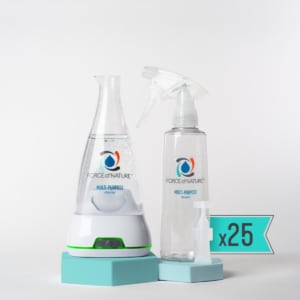
Force of Nature is a cleaner and EPA-registered disinfectant you make right on your countertop.
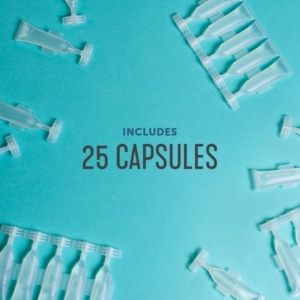
It’s an appliance that uses electricity to convert tap water, plus a small Activator Capsule containing salt, water, and vinegar, into a formula containing two hardworking ingredients: hypochlorous acid, which disinfects and deodorizes, and sodium hydroxide, which cuts through grease and grime.
One bottle replaces a whole bunch of products around the house because you can use it for cleaning, deodorizing, and disinfecting.
It’s made without bleach, quats, ammonia, fragrance, dyes, surfactants, or preservatives.
And yes—it actually disinfects.
Force of Nature kills 99.9% of germs, including Salmonella, Norovirus, Influenza A, MRSA, Staph, Listeria, E. coli, and Pseudomonas, when used as directed on hard, non-porous surfaces.
If you’re thinking, “Okay, but does this countertop science experiment really work?”—fair question. You can see the independent testing behind those claims in our Force of Nature test results. Tl;dr—Force of Nature is proven to clean just as effectively as the leading brands.
How to Choose the Best Non-Toxic Cleaning Products for Your Home
The “best” cleaning products aren’t necessarily the ones with the prettiest packaging or the longest list of things they don’t contain.
Look for products that check the boxes that actually matter to you:
They work. Because we are all busy enough without needing to clean the kitchen twice.
Their ingredients make sense for your family. Maybe that means no fragrance. Maybe you’re avoiding bleach or quats. Maybe eczema or asthma is part of the picture.
Their claims have evidence behind them. Independent testing and credible certifications are a whole lot more useful than vague promises.
They do the job you think they do. A cleaner cleans. A disinfectant should actually be EPA registered to disinfect.
You’ll actually use them. Because the safest product in the world isn’t terribly helpful if it lives under the sink untouched because it takes forever to work or requires six different bottles to clean one bathroom.
For families with little ones crawling, licking, touching, and generally investigating every square inch of the house, our guide to the safest cleaning products for kids and babies gets more specific about what to consider.
And because apparently pets also did not receive the memo about staying off freshly cleaned surfaces, we have a separate guide to pet-safe cleaning products too.
The Bottom Line
Look past vague claims. Pay attention to ingredients. Skip things you don’t need, like fragrances and dyes. Look for independent testing and meaningful certifications. And make sure the product actually does what you’re buying it to do.
For everyday cleaning, there are plenty of safer options.
If you need to disinfect or deodorize as well, the field gets narrower—which is exactly why we created Force of Nature.
It gives families one product for cleaning, deodorizing, and EPA-registered disinfecting, without bleach, quats, ammonia, or fragrance.
Because you already have enough decisions to make today. Your kitchen spray really doesn’t need to be one of the hard ones.